

Welcome to the captivating story of Manipur, a beautiful state in northeastern India with a fascinating history, which is known for its scenic beauty and cultural richness. The state which is home to various ethnic groups, is a victim of insurgency. Recently, there have been troubling events that we must address.
Imagine a place filled with lush green hills and colorful traditions. That’s Manipur! But despite its beauty, the state has faced some difficult times lately. There was a disheartening incident which is extremely shameful and inhuman, where a group of people demoralized two women in public. This event has raised serious concerns about the safety and respect for people in the region.
As we look into Manipur’s past, we’ll discover tales of bravery, culture, and the struggles it has faced. The people here have a strong spirit, and they’ve been through many ups and downs. We’ll also see that Manipur is known for its unique traditions and the fight for its identity.
This article will take you on a journey through Manipur’s history, highlighting its joys and challenges. We’ll learn about the recent incidents that have shaken not only the state itself, but the whole nation and how they connect to its past. Together, we’ll explore the importance of understanding the reasons and the methods to curb these events to build a better future where everyone can live in peace and harmony. So, let’s begin with the exploration of Manipur – a land of strength, diversity, and hope.
History of Manipur
The captivating history of Manipur, a region rich in cultural heritage and diversity, offers a blend of myths and historical accounts. While the Cheitharol Kumbaba, the court chronicles dating back to 33 AD, provides initial traces of Manipur’s history, it amalgamates mythical narratives with factual events. However, an undeniable fact emerges: the existence of the Meitei Kingdom, believed to have commenced with the reign of King Pakhangba, also known as the Serpent King – this sentence looks incomplete???. In this blog, we will explore the intriguing interplay between myth and history, shedding light on the ancient traditions of Sanamahism practiced by the Meiteis and the coexistence of the Naga community, alongside occasional conflicts with the Meitei Kingdom.
The Cheitharol Kumbaba: Unveiling the Blend of Myth and History:
The Cheitharol Kumbaba, a significant historical source, offers a vivid tapestry of Manipur’s past. Comprising a mixture of myths, legends, and recorded events, it presents a unique challenge in discerning historical accuracy. Nevertheless, it serves as a valuable starting point for understanding Manipur’s early history.
The Meitei Kingdom: Tracing Its Origins to King Pakhangba:
Within the realm of myth and historical interpretation, the Meitei Kingdom emerges as a central narrative. King Pakhangba, revered as the Serpent King, is believed to have laid the foundations of this ancient kingdom. While today most Meiteis adhere to Hinduism, it is noteworthy that their ancestral beliefs were rooted in Sanamahism, an indigenous religious system.
The Naga Community: A Parallel Presence in Manipur:
Sharing the land of Manipur with the Meiteis, the Naga community has long played a significant role in shaping the region’s history. Despite occasional conflicts, the relations between the Nagas and Meiteis have witnessed periods of stability and coexistence.
The Dynamic Relationship: Nagas and Meitei Kingdom:
Throughout history, the Meitei Kingdom experienced intermittent raids by the Nagas. These incursions underscore the complex interplay between these two communities, highlighting the delicate balance between conflict and cooperation.
In the late 18th century, the British made their presence known in Manipur. In 1762, Raja Jai Singh of Manipur entered into a pact with the British to seek their assistance in defending against Burma (Myanmar) invasions. The British, recognizing the need for reinforcements to protect against Burma’s incursions as well as Naga raids, decided to relocate a new community known as the “Kuki” to Manipur, allowing them to settle in the foothills of the region.
During the colonial period, Manipur faced continued invasions from Burma, contrary to the expectations of the British. In addition, Naga raids persisted, further complicating the situation. In a significant event, Burma occupied Manipur from 1819 to 1826, a period known as the Seven Years of Devastation. This occupation came to an end after the First Anglo-Burmese War, in which the British defeated Burma and removed their presence from the region. Subsequently, the British assumed the role of protectors of Manipur.
During this time, the British installed a puppet king to govern Manipur. However, in 1890, a palace coup took place, prompting the British to once again intervene in defense of Manipur. This conflict became known as the Anglo-Manipur War, which resulted in British victory. Following the war, a puppet king named Chura Chand, who was only five years old at the time of his swearing-in, was installed as the ruler.
During World War I, when the British requested soldiers from the then Maharaja Chura Chand, the Naga people were willing to contribute, but the Kuki tribe refused and instead launched a revolt against the British. After two years of fighting, the Kukis were eventually forced deep into the jungle. These historical incidents continue to have an enduring influence on Manipur’s demography.
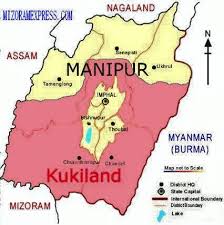
The demographic and land ownership dynamics in Manipur are as follows: The Kuki community, comprising 28% of the population, holds approximately 90% of the total land area. On the other hand, the Meitei community, accounting for 53% of the population, only possesses 10% of the land. Despite this disparity, relations between the two communities have remained relatively stable. The Kuki people were initially brought in to safeguard the Meitei community, and there have been no significant conflicts between the two groups.
In 1947, Manipur acceded to India, and two years later, it became a Union Territory. Around this time, the Naga insurgency began in Nagaland. The Meitei community also took up arms against both India and the Nagas. Subsequently, the Kuki community also established their own insurgency groups with the aim of obtaining a separate state within India, referred to as “Kukiland.”
As a result, Manipur found itself facing a trio of insurgencies, with each group harboring animosity towards the others. Unfortunately, these conflicts have led to deep-rooted tensions and ongoing hostilities. In 1993, violent ethnic clashes erupted in Manipur, resulting in the loss of hundreds of lives and the displacement of thousands. Regrettably, the wounds from these conflicts have yet to heal.

Why is Manipur facing riots?
The Meitei people express concern over the erosion of their language, culture, and changing demographics due to illegal migration from Myanmar by the Kuki community. They seek recognition as a Scheduled Tribe, hoping to gain access to educational and job opportunities. On the other hand, the Kuki community opposes this, arguing that the Meiteis have historically held positions of power in the state.
The current situation in Manipur is a culmination of various factors, including ancient geopolitics, colonial influences, and geographical constraints. Unfortunately, successive leaderships have not been successful in integrating the Northeast region into the mainstream, which has given rise to insurgencies.
The key to resolving these issues lies in the government’s ability to build trust with the various ethnic groups in Manipur. By fostering understanding and cooperation, violent incidents can be curbed, and a path towards peace and reconciliation can be paved. It is crucial to address the grievances of both the Meitei and Kuki communities, acknowledging their unique identities and aspirations.
Blaming one factor alone would be oversimplifying an inveterate problem. Instead, a comprehensive approach that takes historical context and contemporary challenges into account is necessary. Only through genuine efforts to bridge divides and promote inclusivity can Manipur hope to forge a harmonious and prosperous future for all its citizens.
 Our Thoughts